

Bristle Worms are a type of worm that can be found in both fresh and salt water.
These worms have many different names depending on the location they’re found, but their appearance is always similar.
They grow to an average length of between six and sixteen inches, with some species reaching up to 3 feet long!
Bristle Worms are often mistaken for leeches or even earthworms, so it’s important to know how to identify them before taking any action.
In this post you’ll learn everything there is to know about bristleworms: identifying them, preventing infestations, and learning interesting facts about these fascinating creatures!
All About Bristle Worms

What Is A Bristle Worm?
There are over 8,000 different types of bristle worms in the world. Freshwater species account for less than 2% of the total, with the rest being marine or brackish varieties.
A Bristle Worm is a type of polychaete (an annelid worm) and can come in many different shapes and sizes.
They’re very common, usually harmless pests that live both above the water line as well as below it!
The segments are made up of pair of fleshy leg-like components called parapodia.
There are also some hair-like bristles in each segment called chaetae, which are composed of chitin.
Different types of Bristle Worms look different from each other based on the shape of their bristles as well as what they are made out of.
They have been found in many regions of the world , including North America, South America, Africa and Europe, in both hot and cold regions.
The two types of bristle worm are sedentary and errant.
- Errant: Move and swim around the aquarium using their parapodia.
- Sedentary: Don’t move around a lot and are either burrowers or live in tubes.
How Big Are Bristle Worms?
In their natural habitat, the size of a bristle worm can range from small microscopic species to 50ft. The worms inside an aquarium are generally 3-8 inches.
What Do Bristle Worms Do?
Bristle worms are scavengers who do a great job of cleaning the substrate, especially in an aquarium where there are heavy eaters. They will pick up leftover food and waste that sink to the bottom of the tank.
They also create burrows through rocks or gravel, which can be beneficial for other types of worms who want to hide from fish.
This makes them good additions for reef tanks because they help cycle nutrients while providing hiding places for small organisms like shrimp fry .
However, their presence is not always desired by aquarists because bristle worms often destroy corals and plants with their constant movement around the aquarium’s floor.
Where Do Bristle Worms Come From?
In the wild they are a natural part of reefs, but Bristle Worms will manage to get inside of your aquarium by hitching a ride on live rock or other aquarium materials that you bring home.
They will also breed inside the tank, and their larvae can survive for up to a year without food before they attach themselves to something in your tank.
Bristle worms are both hermaphroditic (having male and female reproductive organs) as well as protandric which means that they begin life by being males but switch sexes later in life if needed.
This makes them extremely prolific breeders because even after losing one sex early in life, they still have another chance at mating.
Can You Touch A Bristle Worm?
There are some that are dangerous and should never be handled, and others that aren’t dangerous.
Use gloves to be on the safe side if you do plan on touching or moving them. The bristles on the outer edge of these worms might detach and irritate your skin.
The Difference Between Bristle Worms And Fireworms
Fireworms are a subspecies or breed of bristle worm that are more dangerous and viewed as pests.
Fireworms may attack your fish, and have bristles coated in poison that can lodge into your skin similar to the pines of a cactus.
Bristle worms are harmless and will be fine in your tank, but if you see Fireworms, they should be removed immediately.
Can Bristle Worms Kill Fish?
Common Bristle Worms will not harm or kill your fish so there shouldn’t be a concern.
If you do happen to see a bristle worm eating on a dead fish, chances are that the fish was already dead in the first place.
Fireworms are a different story and can harm and kill fish as they are carnivores.
The bristles on their bodies are coated in poisons that cause stings, and they will generally attack smaller fish that are slow.
What Do Bristle Worms Eat?
Bristle Worms are mostly scavengers and eat most things you feed your fish.
They can also be eaten by some of the larger species such as tangs and angelfish, so if they are big enough this is one way to eliminate them from your tank.
If one of your fish dies, you may also see these worms eating them, as well as leaves and algae.
Should Bristle Worms Be Removed From Your Aquarium?
A common question asked by aquarists is, should you remove bristle worms from the aquarium?
This all depends on which species you have, but most of the time you should be fine leaving them in the tank.
The only time to be concerned is if you have a large fireworm that is attacking your fish.
Other than that, Bristle worms are great to keep in the tank because they are incredible cleaners who keep your tank clean by removing anything dead or rotting.
Types Of Bristle Worm
The Common Bristle Worm (Polychaete)
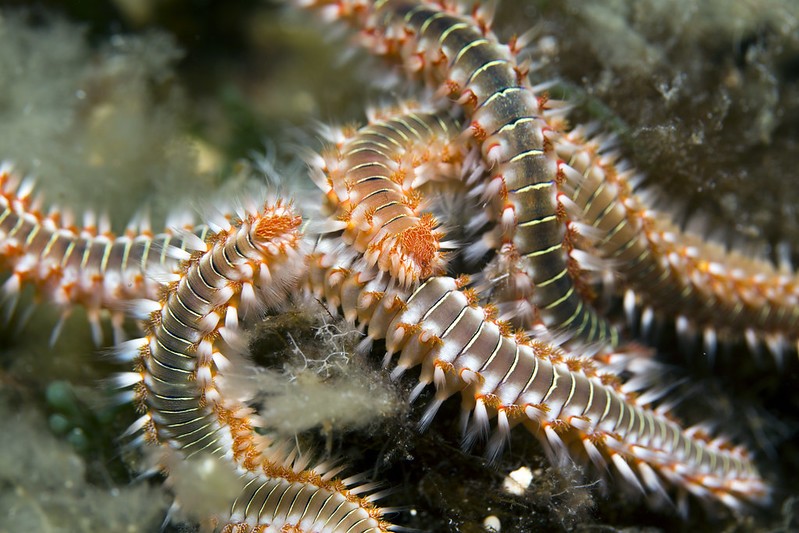
Image Credit: prilfish
The common bristle worm is a harmless scavenger that usually gets into your aquarium via rocks and other decorations that you place in there.
The Bearded Fireworm (Hermodice carunculata)
They have white and red bristles on their bright colors, which may be gray, crimson, yellow, or green, and generally grow up to 6 inches, with some growing as large as 12 inches.
These are the bad guys who must be removed from your tank. This is why it is so important to know the difference between these, and the common Bristle Worm.
Red-Tipped Fireworms (Chloeia Virdis)
With two stripes running down the centre of their backs, these are also bad guys just like the Bearded Fireworm.
You can also recognise them by their red to brown body that is heavily covered in red and white bristles.
How To Remove Bristle Worms From Aquariums
If you want to remove Bristle Worms from your aquarium, here are a number of techniques you can use.
Natural Predators
There are many types of natural predators that you can add into your tank, that will do an excellent job of controlling other organisms in your tank such as Bristle Worms.
Here are some popular choices you can use:
- Arrow Crab
- Sunset Wrasse
- Dottyback
- Maori Wrasse
- Wrasse
- Coral Banded Shrimp
- Bird Wrasse
Bristle Worm Traps
If you don’t want to add natural predators to your tank, just for the sake of controlling Bristle Worms, traps are the next best thing.
Bristleworm traps are exactly what they sound like, a small trap that is put into your tank to catch Bristle Worms.
You can either buy a trap or make one yourself.
You can make one yourself by using a small plastic container like an old baby food jar.
Mark the top of the jar with where you want to cut it so that your trap is open on both ends.
Use either hot glue or superglue to attach some fishing line onto the inside of your lid.
Then put some bait into your trap, such as raw shrimp , fish fillet, etc., then place another piece of bait in front of the string or fishing line.
The Bristleworms will be attracted by this second piece of bait and climb up through the hole at the top trying to get it but they won’t be able too because their bodies are just too big for them to fit through.
Manually Removing Bristle Worms
It is possible to remove Bristle Worms from the aquarium by hand.
However, you should wear gloves while doing this because the bristles of these creatures can get stuck under your nails and make them very hard to remove.
If some worms are left behind after removing with a net then it is possible that they might still be alive but simply hiding somewhere in the rocks or gravel at the bottom of the tank.
There’s also always a chance that they could regenerate into new bristle worms if conditions inside your aquarium change for better or worse.
Common Questions
Are bristle worms bad?
Bristle worms are actually good for your tank because they are scavengers who keep your tank clean by consuming uneaten food and other debris.
Fireworms are bad and should be removed from your tank immediately.
What happens if you touch a bristle worm?
Bristle worms are not aggressive, but touching them might cause them to release their toxins in self-defense.
These bristles can penetrate the skin, similar to the pines of a cactus, and cause the following:
- pain
- burning sensation
- redness
- swelling
- a rash
If you do touch a bristle worm, rinse your hands with freshwater and try not to rub or scratch the area that was touched for at least 30 minutes.
Bristle Worms Conclusion
Now you know everything there is to know about Bristle Worms and their habits.
Bristle worms are fascinating creatures and many people may not even know they exist.
The only way to be sure that a bristles worm doesn’t end up in your aquarium or pond, is by making sure they never get inside of it!
Any kind of rocks or decorations should be checked before placing them inside of your aquarium.
If they do happen to get into your tank then it’s not the end of the world, providing they are not fireworms which should be removed immediately.
Have you ever had Bristle Worms in your aquarium, let us know in the comments below.
