


Ghost Shrimp who are also know as Glass Shrimp are available at most local pet stores and are very easy freshwater aquarium shrimp to keep.
They are very popular because they are inexpensive and are often used by fish keepers as “feeders” for larger fish. Ghost Shrimp are not only used as a snack, they are also fun to watch and make great cleaners for your aquarium.
In this guide I’m going to cover all of the information you need to know on Ghost Shrimp including appearance, lifespan, diet, breeding, and how to set up a ghost shrimp tank.
Ghost Shrimp Overview
Care Level: | Easy |
Temperament: | Peaceful |
Color Form: | Clear |
Lifespan: | 1 year |
Size: | 1.5 inch |
Diet: | Omnivore |
Family: | Palaemonidae |
Minimum Tank Size: | 5-10 Gallons |
Tank Set-Up: | Tropical Freshwater: Caves & Plants |
Compatibility: | Small Peaceful Fish |
Ghost Shrimp originated in 1850 in North America and have been very popular in home aquariums ever since. ‘Ghost shrimp’ is actually a name used for varieties of shrimp with Ghost shrimp being the most popular that belong to the Palaemonetes family.
Ghost shrimp are a great addition to your aquarium because they help keep your tank clean by clearing up uneaten food and they also help to keep algae levels down. They are always active and busy so this cleaning process is continuous.
A single shrimp can happily function on it’s own so a whole group of them is not always necessary. The main thing to check when purchasing Ghost shrimp is if they have been bred for aquariums or as feeder fish. This is because feeder fish will not survive as long as they are generally treated very poorly.
Appearance of Ghost Shrimp

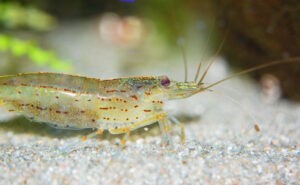
The reason why ghost shrimp are so great at evading predators is because they are mostly clear in color. The fascinating thing about this is that as they process food, the inner-workings of their body can clearly be seen. Some specimens also come with various colored dots on their backs.
How Big Are Ghost Shrimp?
Ghost shrimp can grow to around 1.5 inches, with females becoming a bit larger than males.
Ghost Shrimp Antenna And Other Features
Ghost shrimp have both a pair of short antenna and a pair of long antenna. On top of their head between the eyes is their rostrum with a carapace area behind that. This is the area where the inner-workings can be seen when they are processing food.
The shrimps legs are very long and slender which are also clear and attach to the underside of the carapace. The legs are their primary method of movement when they are feeding on the bottom of the tank.
Abdominal Segments
Six abdominal segments can be found behind the carapace which form a flexible covering. A slight pointed area is raised a touch higher between the third and fourth abdominal segments.
Swimmerets are clear and can be seen fluttering around under the abdominal segments as the shrimp moves through the water. Eggs are tucked under the abdominal segments in female shrimp near to the carapace.
Tail
The tail connects to the sixth abdominal segment and is made up of moving segments that are thin, flat, and flexible. There are four segments of soft shell that make up the uropod which can be found under the telson which is located in the middle of the tail.
The uropod can make the tail become broad and narrow by expanding and contrasting. Fine filament-like “fringe” can be found around the edges of the uropod.
Color Range
The body of a ghost shrimp is very translucent with a touch of either light grey or dark grey. They can also sometimes have tiny green dots on theirtorso. Being able to see the inside workings of a ghost shrimp make them very fascinating.
Ghost Shrimp Lifespan and Molting
The lifespan of ghost shrimp will vary depending on the individual, but it’s usually around one year. The death rate can happen a lot quicker because they are often kept in poor filtration due to them being so cheap and used as feeder fish.
As they eat and grow they will regularly molt, even though their lives are very short. This process makes they become more vulnerable until their new shell hardens. This is why it is a good idea to ensure your tank has plants to provide a hiding space for molting shrimp.
Other shrimp in the tank will eat the shells that have molted, so there is no need to remove them if you see them in the aquarium.
How To Use Ghost Shrimp As Feeders
You can use any size tank to keep the ghost shrimp in if you plan on using them as feeders. You do not need any live plants or gravel in the tank but you should have a constant flow of air bubbles which keeps the water moving.
All you will need for this is a small air pump, a small air stone, and a few feet of tubing. If you are going to keep the ghost shrimp in this tank for a while, then a small sponge filter such as the Lefunpets Biochemical Sponge Filter is recommended.
Ghost Shrimp Diet and Feeding
It’s a good idea to put their food in a large dish as shrimp are messy eaters. The dish will prevent food from sinking into the substrate. The large dish also gives less aggressive shrimp more of a chance to eat.
What Do Ghost Shrimp Eat?
As ghost shrimp are omnivores, this means that they will eat pretty much anything. This includes:
- Flake food
- Shrimp food pellets
- Globs of algae
- Blanched vegetables like spinach, romaine, cucumber or zucchini
- Algae wafers
- Blood worms
- Leaves (Indian almond leaves are a favorite)
- Spirulina
How Often Should I Feed Ghost Shrimp?
As shrimp constantly feed by grazing on flake food and other stuff in the tank, you will only need to feed them around four times a week. If you have a large quantity of ghost shrimp then you could potentially feed them every day.
If they are leaving a lot of food then make sure to to remove it from the tank and switch to feeding them every other day instead. if they don’t eat the food within the first 10 minutes then this is a sign that they are not really hungry. In this case you should remove the food and give them a day or two before you feed again.
Ghost Shrimp Compatibility With Other Fish
Although they are very peaceful, you’ll have to be aware of what kind of fish you put them in with because some fish are aggressive and will eat them. Here are a few examples of good tank mates:
- Small barbs like the cherry barb
- Danios
- Characins such as tetras and hatchetfish
- Peaceful loaches like zebra and kuhli loaches
- Small catfish like those of the Corydoras genus
- Other shrimp such as vampire shrimp, amano shrimp, and bamboo shrimp.
I’m not going to go through the fish that shouldn’t be mixed with ghost shrimp because there is such as large range. The one tip you should keep in mind is that if a fish has a mouth that is large enough to eat shrimp then do not mix the two.
You also shouldn’t mix shrimp with fish that are well known for being territorial or hostile.
Breeding Ghost Shrimp
Glass shrimp are quit easy to breed providing they are kept in a healthy environment and away from predators. This is the one of the main reasons why people use them as feeder fish. You should have a separate breeding tank for this process.
Females are easy to spot once they have matured because they develop a green saddle underneath their body and they also grow larger than male ghost shrimp. Females should produce eggs every few weeks. You’ll know when they have because they appear as green dots which are attached to their legs.
As soon as you spot this, wait for a couple of days to give the males a chance to fertilize them. One you have left it a few days you should then move the females into the breeder tank before the eggs hatch.
As soon as the eggs hatch, move the female back to the main tank. This is important to prevent them from eating the young shrimp. It’s important to have a sponge filter to prevent the young shrimp from getting sucked into the equipment.
The breeder tank should have a thin layer of sediment and have a few plants which will be a food source for the young shrimp. As they have very tiny mouths, you can also feed them a small amount of fine particle food. You can start to feed them the same food as the adults once they start to grow legs.
They should be fully grown after around five weeks and can then be moved into the regular tank.
Conclusion
If you keep or breed ghost shrimp then let us know your thoughts or any further tips in the comments section below.
Other freshwater fish that may interest you:
